In family law, child custody can be tough, especially when one parent takes on most, if not all, of the default parent responsibilities. It’s normal for one parent to become the main caregiver. This often happens naturally because of things like work schedules, personalities, or who seems more interested in caregiving.
The “default parent” is talked about more and more these days, but families dealing with custody decisions need to know what it means legally, especially under Texas law. This is important for a healthy family dynamic.
What Does It Mean to be the Default Parent?
The “default parent” usually handles most of the tasks related to their child’s well-being. Who packs lunches, remembers doctor appointments, helps with homework, and provides emotional support? Chances are, one parent comes to mind—the likely default parent.
This might seem fine initially, but it can cause problems for both the parent and the family. Resentment can build, and the overwhelmed and underappreciated parent may experience a negative impact on their relationship and their child’s well-being.

How Default Parent Responsibilities Factor Into Texas Custody Cases
Texas courts decide custody based on what’s best for the child. They consider many things when figuring out conservatorship (who makes decisions) and possession and access (physical custody).
Courts want children to have relationships with both parents if it’s safe. They might also order one parent to pay child support, which is decided using state guidelines.
Understanding Conservatorship in Texas
Conservatorship is a big deal in Texas custody cases. It helps us understand the role of the default parent. People often think “custody” is the main thing, but Texas law splits it into “conservatorship” and “possession and access.”
Types of Conservatorship
Texas courts prefer to make parents Joint Conservators, giving both parents rights and responsibilities. However, this isn’t always a 50/50 split in decision-making. Let’s look at the types of conservatorship:
- Joint Managing Conservatorship: This is the most common in Texas. One parent is usually the custodial parent, deciding where the child lives. This often reflects who has been the default parent.
- Sole Managing Conservatorship: This means one parent has all the rights and responsibilities for the child. Courts usually only do this if family violence, neglect, or substance abuse puts the child at risk.
How parents already handle things like schedules, healthcare, and education plays a big part in who the court says is the custodial parent. This affects where the child primarily lives and their daily routine.
Factors Influencing Custody Determinations in Texas
To understand how being the default parent can affect legal decisions, it’s important to understand how Texas courts decide what’s in a child’s best interest:
- Child’s wishes (if they’re old enough to say)
- Parent-child relationship
- Each parent’s ability to provide a stable, loving environment
- History of domestic violence (courts take this very seriously)
- Ability to co-parent and put the child’s needs first (conflict can hurt a parent’s case)
- Anything else the court thinks matters
Impact of Default Parenting on Legal Decisions
When deciding if parents have a good relationship with their child and provide a stable home, the court might look at who has been the default parent. A parent who’s always been the main caregiver may have an advantage in a custody case. For example, a study found that even when both parents worked full-time, mothers still had more of a mental load than fathers (Allen et al., 2023). They did more parenting tasks, regardless of work hours, showing that society expects women to be the primary caregivers.
Here’s the problem: Sometimes, being the default parent isn’t a choice both parents make together. One parent may feel like they *have* to step up, while the other doesn’t realize things are unequal, even if they mean well. This can create a parenting TikTok trend of one parent feeling overwhelmed.
Texas Statistics Highlighting the Impact of Default Parent Responsibilities
Default parenting isn’t just something people talk about—statistics show it’s a real thing:
- Pew Research Center (2015) found that mothers (27%) were much more likely to stay home with their kids than fathers (7%). This study focuses on stay-at-home parents but shows that women are often expected to be the main caregivers. This contributes to the default parent syndrome.
- According to the U.S. Department of Labor (2022), in families where both parents worked full-time, mothers spent about 1.75 hours each day on childcare, while fathers spent 1.01 hours. This data comes from many families and shows that mothers usually do more childcare, which a judge may consider when deciding custody.
- The CDC’s National Center for Health Statistics (2023) says that around 40%-50% of marriages end in divorce. This means families are often restructured, and custody and support orders are needed. In these cases, the court often looks at who was the default parent. The default parent may become the custodial parent and receive child support. This highlights how default parenting can have lasting legal and financial effects after separation.
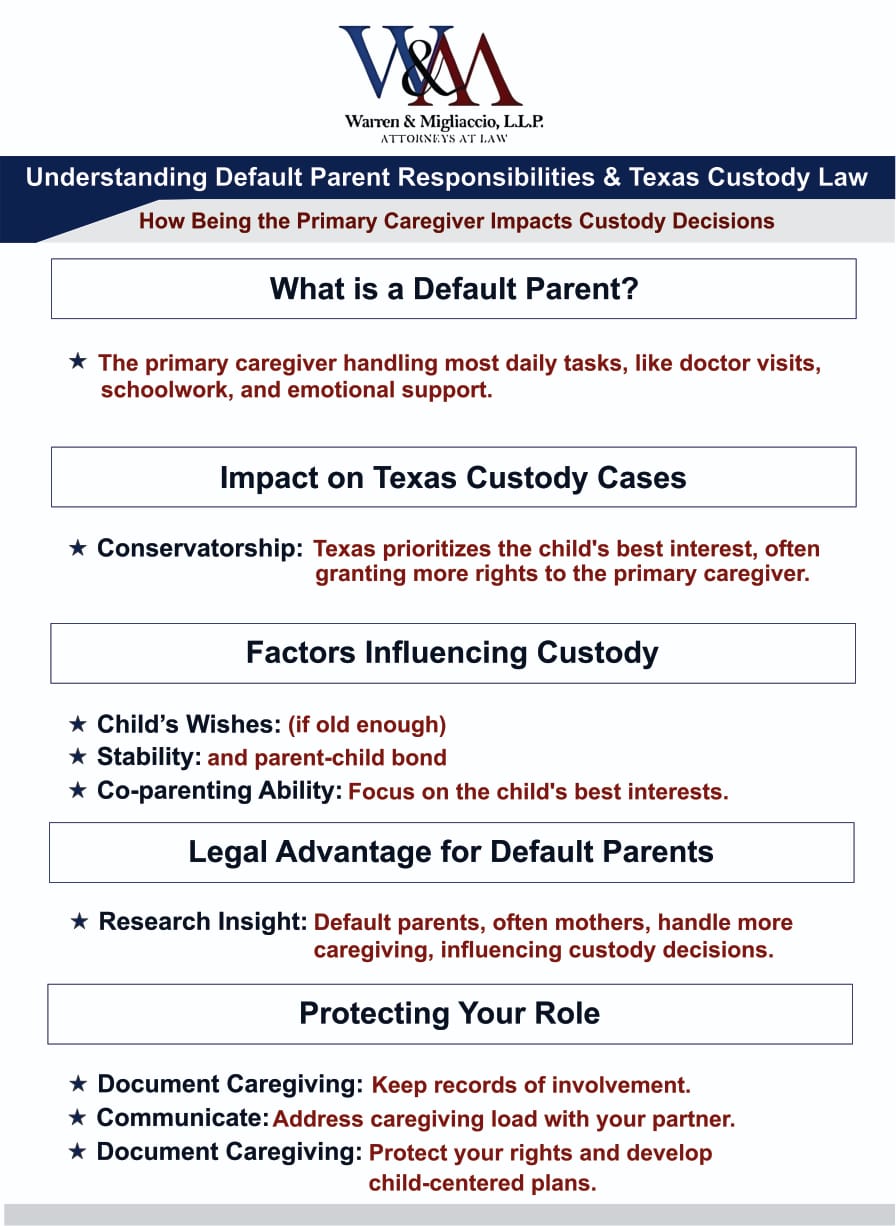
Learn about default parent responsibilities and how Texas law impacts custody decisions in this infographics.
Addressing the Default Parent Dynamic: Protecting Your Rights & Best Interests
If you’re the default parent, here are some things to think about, especially in Texas:
- Documentation is key. Keep records that prove you’re the primary caregiver. Save things like medical records, school papers, and schedules. This shows that you’ve been consistently involved in your child’s life, which can help if there’s a custody dispute.
- Engage in open communication: Talk to your partner. If you’re overwhelmed with default parent tasks, share how you feel. Explain how it affects you—maybe it’s hurting your career, mental health, or personal goals. Open and honest conversations will benefit you and your child.
- Consider seeking legal counsel. If you’re worried about custody, talk to a family law attorney in Texas. They can explain your rights, help you explore your legal options, and help create a parenting plan that’s best for your child. An attorney ensures your concerns are heard legally.
Conclusion
Dealing with being the default parent can be hard, but many parents experience this. It’s bigger than just how parents choose to do things—it affects how courts in Texas decide what’s best for a child, which shows up in custody cases. If you’re a parent in Texas, knowing how this works legally is the first step to protecting yourself and planning for the future.