
Can utility bills be included in chapter 7 bankruptcy in Texas? Yes, in most cases past-due utility bills can be included and discharged, but you must keep paying future utility bills and you may have to post a new deposit to keep service on. Cable, internet, and cell phone service may not get the same protection.
| Topic | Pre-filing bills (owed up to filing date) | Post-filing bills (charges after filing) |
|---|---|---|
| What it means | Past bills are the balance owed up to your filing date. | Future bills are charges after filing; you remain responsible for future service. |
| Who pays it | A bankruptcy discharge typically wipes out your personal responsibility for old balances. | You remain responsible for future utility bills after you file. |
| Chapter 7 discharge effect | In most cases, past-due utility bills can be included and discharged. | Chapter 7 does not pay for service after filing; new charges remain your responsibility. |
| Shutoff risk after filing | Filing Chapter 7 usually stops a shutoff tied to a past-due balance. | Service can still be shut off for nonpayment of new bills. |
| Adequate assurance / deposit | Not specified in the article | The utility may request adequate assurance within about 20 days; service can be terminated after that period if you do not provide it. |
| Exception mentioned | Utility debts tied to fraud or theft of service may not be discharged. | Not specified in the article |
If a utility shut off notice is sitting on your counter, the legal question is only half the problem. The other half is timing, paperwork, and how fast the utility company wants “payment assurance.”
At Warren & Migliaccio, L.L.P., our Lead Counsel Verified attorneys have helped North Texas families get a fresh start since 2006. We offer free consultations in Dallas, Collin, Denton, and Tarrant counties. Call (888) 584-9614 to talk through your options.
Related: Chapter 7 Bankruptcy in North Texas
Related: Bankruptcy
Related: The Bankruptcy Process – What You Need To Know About Chapter 7
What key Chapter 7 utility terms should Texas filers know?
These terms control what happens to your utility services after a bankruptcy filing. The short version is this: Chapter 7 can wipe out many past due utility bills, but it does not pay your bills going forward. Most Chapter 7 cases end in a discharge, but not cases that are dismissed or converted.⁸
Term |
Plain-English meaning |
|---|---|
Chapter 7 bankruptcy |
A bankruptcy process where a bankruptcy trustee can sell nonexempt assets to repay creditors, and the rest of eligible debt is discharged. |
Bankruptcy discharge |
A court order that stops collection actions on many unsecured debts, like utility bills, medical bills, and credit cards.⁸ |
Automatic stay |
A federal law pause on most collection actions after you file bankruptcy.¹ |
Pre-filing vs. post-filing utility bills |
Past bills are the balance owed up to your filing date. Future bills are charges after filing. You remain responsible for future service. |
Adequate assurance |
Proof you will pay future utility payments, often a cash deposit or other security.² |
20-day deadline |
Utilities can demand adequate assurance, and service can be cut after about 20 days if you do not provide it.² |
Bankruptcy court / judge |
The court that oversees your bankruptcy case and the bankruptcy judge who resolves disputes. |
Means test |
An income-based test used to determine if you qualify for Chapter 7. |
Utility provider vs. non-utility services |
Electric, water, and gas are usually treated as utilities. Cable and internet may not be treated the same way.⁷ |
Texas terms: REP, TDU, municipal utility |
In many areas, a Retail Electric Provider (REP) bills you and a TDU maintains lines. Municipal utilities and co-ops often have different rules. |
Texas-specific utility twists after filing Chapter 7
Chapter 7 is federal law, but your day-to-day utility experience in Texas can depend on who provides the service. Electricity may run through a Retail Electric Provider (REP) in deregulated areas, while co-ops and municipal utilities can follow different policies. The next sections explain Texas deposit limits and provider differences so you can plan for deposits and keep service on without a gap.
How do Texas electricity rules affect utility deposits after Chapter 7?
In many parts of Texas, your “power company” is a Retail Electric Provider (REP), and Texas rules limit what a REP can demand as a deposit. That matters because most people filing Chapter 7 are not only worried about old bills. They are worried about coming up with a new deposit fast.
Texas rules on REP deposits are detailed, but one key point is easy to understand: a REP’s total deposit for a residential customer cannot exceed the greater of (1) one-fifth of the customer’s estimated annual billing or (2) the sum of the estimated billings for the next two months.³ Many deposits end up looking like about two months of average charges, but the cap is tied to estimated usage and billing.³
This is also where Texas can be different from generic national advice. In deregulated areas, customers can often compare other REPs if one demands a high deposit. That can help, but it must be handled carefully so you do not trigger a gap in future service or miss a deadline tied to the bankruptcy code.
Co-ops and municipal utilities may follow different policies than REPs. A quick legal review can prevent expensive surprises.
Who should use Chapter 7 for utility bills in Texas and who should not?
Chapter 7 is often a good fit when the real problem is unsecured debt that will not stop growing.
| Best for: | Not for: |
|---|---|
|
|
We handle Chapter 7 cases in Dallas, Collin, Denton, and Tarrant counties. If you live outside North Texas, this guide still helps, but local court practice can vary.
What must Texans know about including utility bills in Chapter 7?
Can past-due utility bills be discharged in Chapter 7 bankruptcy in Texas?
Yes, most past-due utility bills can be discharged because they are usually unsecured debts. When you file bankruptcy, you can include utility bills owed up to the filing date, along with many other unsecured debts like medical bills and credit cards.
A bankruptcy discharge typically wipes out your personal responsibility to pay those old balances.⁸ You still must list each utility provider in your bankruptcy filing, with the correct name and address, so the bankruptcy court can send notice.
One major exception: utility debts tied to fraud or theft of service such as illegal hookups or meter tampering may not be discharged and can create bigger problems than a bill.
Related: Does Bankruptcy Eliminate All Debt in Texas?
Will filing Chapter 7 stop a utility shut off in Texas?
Yes, filing Chapter 7 usually stops a shutoff tied to a past-due balance because the automatic stay blocks most collection actions.¹ Utilities also cannot refuse service only because you filed bankruptcy.²
That said, bankruptcy is not a “free power” card. The utility company can still require adequate assurance for future service, and service can still be shut off for nonpayment of new bills.
If a disconnection happens after a bankruptcy filing, keep records, take screenshots, and get legal help quickly. In some cases, the bankruptcy court can address violations of the automatic stay.
Case Study: Kept the Lights On by Managing the 20-Day Utility Deposit Deadline
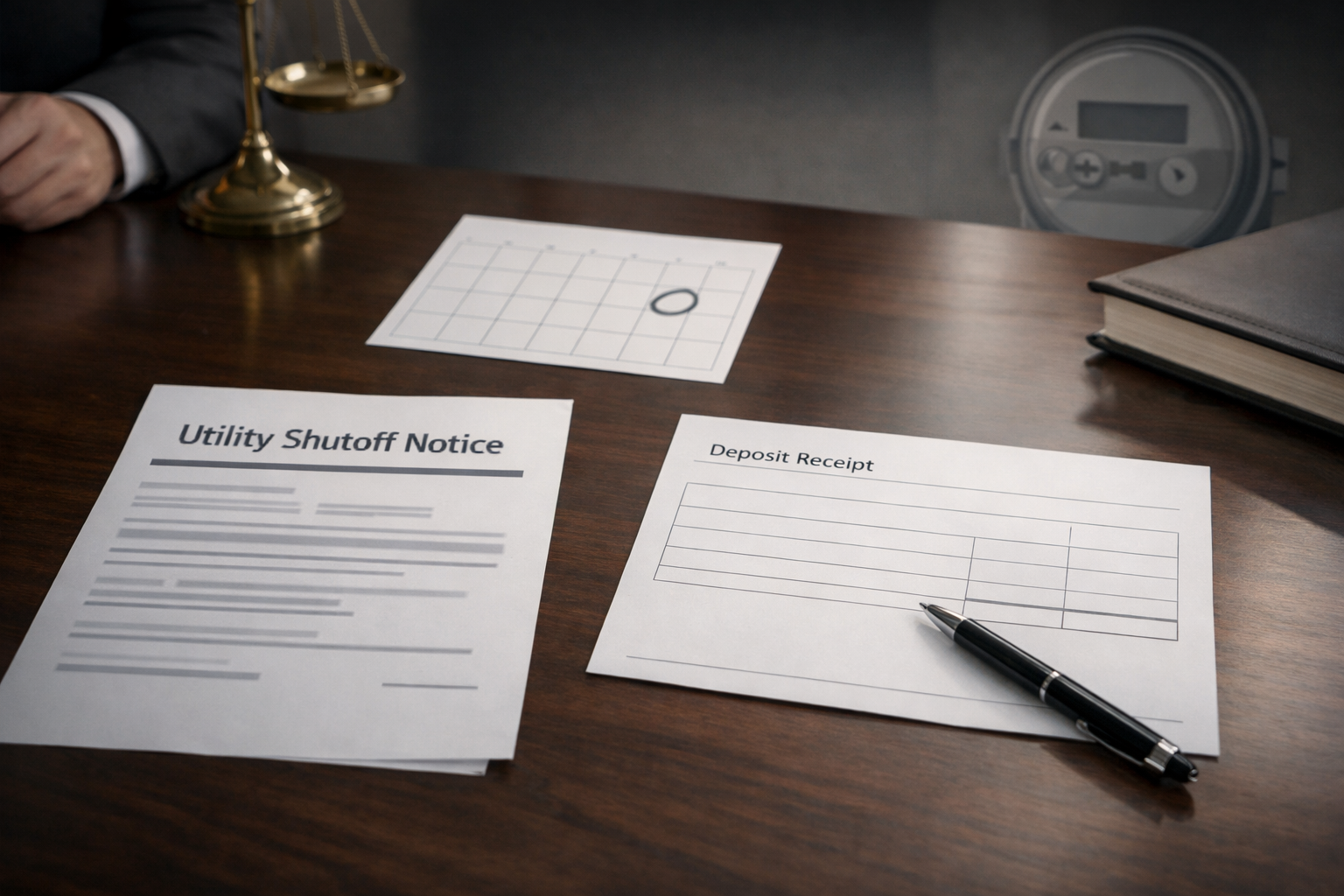
Problem: A North Texas parent came in with a disconnection notice and a shutoff date coming fast. The balance was not huge, but there were kids in the home, and they believed bankruptcy would freeze every bill.
Action: We explained the automatic stay and the 20-day utility rule, then called the Retail Electric Provider together. We pulled the account history, asked for the deposit demand in writing, mapped adequate assurance options, and compared other REPs in the same TDU area to avoid a gap in service.
Result: They left with a clear, deadline-driven plan to keep service on and still move toward a fresh start.
Takeaway: Utilities can still require adequate assurance on a short timeline, so written demands, records, and a concrete plan matter.
What is “adequate assurance,” and why is the 20-day deadline so important?
Adequate assurance is the utility’s right to ask for a deposit or other security so it feels safe providing future service after you file.² In Chapter 7, the bankruptcy code gives utilities a short window to ask for this payment assurance, and it gives you a short window to respond.
Under federal law, utilities can continue service after a bankruptcy filing, but they may request adequate assurance within about 20 days of the order for relief.² Adequate assurance can be a cash deposit, prepayment, letter of credit, certificate of deposit, surety bond, or another form the utility accepts.²
If you do not provide it, the utility provider can terminate service after that 20-day period.² Ask for the deposit demand in writing and keep proof of payment, receipts, and account notes.
Do you still have to pay future utility bills after you file?
Yes, you remain responsible for future utility bills after you file. A bankruptcy discharge covers past debts, not new charges that happen during the bankruptcy process.
Missing post-filing utility payments can still trigger a shut off, even if the old balance is discharged. A simple calendar reminder or autopay can prevent a new crisis.
Are internet, cable, and cell phone bills treated like utilities in bankruptcy?
No, cable, internet, and cell phone service may not be treated like “utilities” for bankruptcy protection purposes. Many Texans assume their phone and broadband are protected like electricity and water, but that assumption can backfire.
In the Fifth Circuit, courts have held that cable service is not a “utility” for purposes of the utility protections in bankruptcy.⁷ Plan ahead for internet and cell phone continuity, especially if those providers are threatening to shut off service.
Can unpaid city water or sewer bills turn into a property lien in Texas?
Yes, in some Texas cities unpaid water or sewer bills can create a property lien, even if personal debt is discharged. Texas law allows a municipality, by ordinance, to impose a lien for delinquent municipal utility service, with a homestead protection concept built into the statute.⁶
This is one reason it matters whether your account is with a municipal utility, a co-op, or a private provider.
What does this look like in a real North Texas Chapter 7 scenario?
Example Illustration: Keeping electric service on with a REP deposit
A Denton County household received a utility shut off notice for a $640 past-due balance and had $18,900 in other unsecured debts. We filed Chapter 7, the automatic stay stopped collection actions, and the REP requested a $180 cash deposit as adequate assurance. The family kept future utility bills current and completed the case with a discharge.⁸
What steps should Texans take to keep utilities on after filing Chapter 7?
To ensure you don’t miss a critical deadline, follow this 10-step roadmap to keeping your lights on after filing
The Texas Chapter 7 Utility Roadmap
10 Steps to Keeping the Lights On (Deadline-Driven Checklist)
Separate Your Bills
Distinguish pre-filing past-due balances from current charges. Know exactly what debt will be discharged.
Identify Provider Type
Is it a REP, TDU, Co-op, or Municipal utility? This determines deposit rules and lien risks.
Gather Financial Records
Collect IDs, pay stubs, tax returns, account statements, and recent utility bills.
List Every Provider
Ensure every utility is listed correctly on your bankruptcy schedules with the proper legal notice address.
File Chapter 7 & Contact Utility Immediately
Once filed, call them. Ask where to send the bankruptcy notice and the “adequate assurance” payment.
Get Request in Writing
Demand the “adequate assurance” (deposit) request in writing. Document names and dates of all calls.
CRITICAL: Meet the 20-Day Deadline
You MUST pay the deposit or post acceptable assurance within 20 days of filing, or risk shutoff.
Pay Future Bills On Time
Maintain current payments post-filing. The bankruptcy only protects pre-filing debt.
Compare REPs (Deregulated Areas)
If a deposit requirement is too high, shop carefully for a different Retail Electric Provider to avoid service gaps.
If Shut Off, Act Quickly
Document an illegal shutoff after filing and contact your bankruptcy attorney immediately.
Legal Authority: Key Statutes Protecting Texas Utility Customers
The key rules come from federal bankruptcy law, with Texas utility rules filling in the real-world details.
Statute Cheat Sheet
Chapter 7 & Utility LawNotable Case Precedent: Darby v. Time Warner Cable (5th Cir.)
Clarifies that cable/internet is generally not considered a “utility” protected under § 366 in this region.
Common Mistakes: Bad Internet Advice vs. Texas Reality
The biggest mistake is thinking bankruptcy makes utilities “pause” without any follow-up.
The Mistake
“Bankruptcy pauses all my utility bills forever.”
The Texas Reality
It only pauses past-due balances. Under federal law, you are legally required to pay all future utility bills on time, starting the day after you file.
The Mistake
“My internet and cell phone are protected utilities.”
The Texas Reality
Courts often treat cable and internet as “luxuries,” not necessities. They may not receive the same protections against shutoff as water or electricity.
The Mistake
“I can just ignore the deposit request letter.”
The Texas Reality
You have a strict 20-day window. If you do not provide “adequate assurance” (a deposit) within 20 days, the utility company has the federal right to alter or discontinue service.
The Mistake
Listing the wrong address or utility name.
The Texas Reality
If the notice goes to the wrong department, the 20-day clock keeps ticking while they are unaware you filed. We ensure the correct legal address is used to prevent surprise shutoffs.
Frequently Asked Questions
Coverage and Discharge Basics
Can utility bills be included in Chapter 7 bankruptcy in Texas?
Yes. When people ask “can utility bills be included in Chapter 7 bankruptcy in Texas,” most past-due electric, water, and gas bills are unsecured debts that can be discharged, unless the balance involves fraud or theft of service.
Utility arrears are usually treated like other unsecured bills, meaning there is no secured property tied to the account. That is very different from debts that are hard to eliminate, like discharge student loans. You still must list each provider in your petition and schedules with the correct notice address so the bankruptcy court sends notice and the discharge reaches that pre-filing balance. Chapter 7 does not pay for service after filing, so new charges remain your responsibility.
Chapter 7 can also involve liquidation. If you have nonexempt other property, the bankruptcy trustee can sell it to repay creditors. That is why the means test and Texas exemptions matter. If the trustee agrees an item is exempt, it is usually protected.
Do I still have to pay utility bills after filing Chapter 7 in Texas?
Yes. Even though “can utility bills be included in Chapter 7 bankruptcy in Texas” is usually “yes” for past-due balances, you remain responsible for utility bills incurred after you file, and nonpayment can still lead to disconnection.
Chapter 7 draws a hard line at your filing date. The pre-filing balance can be discharged, but the utility service you use after filing is a new obligation. Utilities can also require adequate assurance under 11 U.S.C. § 366, which often means a new security deposit. Many people assume the case “freezes everything,” then get surprised when a post-filing bill is missed or a deposit is not paid.
If you are juggling money and deadlines, use a simple checklist: identify the first bill that covers post-filing service, confirm where to pay the deposit (if one is requested), and put future due dates on a calendar. Clean records also help when you have to answer questions about income and expenses.
Autopay or reminders plus saved receipts prevents most post-filing shutoffs. If you want help building a payment plan around your case, a bankruptcy attorney can walk through it with you.
Are internet, cable, and cell phone bills treated like utilities in bankruptcy?
If you are asking “can utility bills be included in Chapter 7 bankruptcy in Texas,” remember service protections are not the same for every provider:
- Usually protected as utilities: electricity, gas, water (11 U.S.C. § 366).
- Often not protected the same way: cable, and sometimes internet or cell service.
- You can list the debt either way, but the right to continued service can differ.
Section 366 limits a covered utility’s ability to cut you off solely because you filed. The issue is that not every service is classified as a “utility” for § 366 purposes. In the Fifth Circuit, Darby v. Time Warner Cable is commonly cited for the point that cable service did not have to be treated as a utility in this context. So, even if your cable or broadband balance is an unsecured debt that can be listed in your schedules, the provider may not be required to keep service on under § 366.
Because internet and phone access can be essential, plan for continuity before filing for bankruptcy, especially if your household relies on remote work or school.
Make one call per provider and ask what it requires to keep service active after bankruptcy notice. Getting the answer in writing is often the difference between calm and chaos.
Shutoffs, Deposits, and Keeping Service On
Will filing Chapter 7 stop a utility shut off in Texas?
Usually, yes. If you are asking “can utility bills be included in Chapter 7 bankruptcy in Texas,” the filing often stops a shutoff based on past-due bills because the automatic stay begins, but service can still be cut for post-filing nonpayment or missed deposits.
The automatic stay in 11 U.S.C. § 362 generally pauses collection activity, including a disconnect aimed at collecting a pre-filing balance. Separately, 11 U.S.C. § 366 prevents a utility from cutting you off solely because you filed, but it also allows the utility to demand “adequate assurance” for future service. If you do not provide that assurance and you do not keep current on new charges, the provider can terminate service even though the old balance may later be discharged.
From a practical standpoint, separate what you owed before filing from what you owe after filing, and get the provider’s deposit request in writing. Keep screenshots of shutoff notices and notes of who you spoke with, because documentation matters if a dispute ends up in bankruptcy court.
If the shutoff date is close, do not wait and hope it works itself out.
What is “adequate assurance,” and how does the 20-day deadline work in Chapter 7?
To keep your utility service on after filing Chapter 7 in Texas, focus on the 20-day ‘adequate assurance’ deadline:
- File Chapter 7 and confirm the utility has your case information.
- Watch for an “adequate assurance” demand (often a deposit).
- Provide the assurance within about 20 days under 11 U.S.C. § 366.
- Keep paying all post-filing bills on time.
- If the demand is too high, ask the bankruptcy court to modify it.
“Adequate assurance” is the utility’s right, under § 366, to ask for security for future service. It is commonly a cash deposit, but it can also be another accepted form of security. Many deposits end up resembling about two months of average charges, but the amount depends on the provider and usage.
Texas electricity rules can matter in deregulated areas. Retail Electric Provider (REP) deposits are capped by state regulation (16 Tex. Admin. Code § 25.478), which gives you a benchmark when a demand feels excessive. If the cap does not resolve it, you may need the bankruptcy court to set a reasonable amount.
Get the request in writing and keep receipts and account notes. Missing the deadline is the quickest way to turn a bankruptcy case into a shutoff problem.
Special Situations and Common Pitfalls
Can unpaid city water or sewer bills turn into a property lien in Texas?
Yes. Even when “can utility bills be included in Chapter 7 bankruptcy in Texas” is answered “yes,” some unpaid municipal water or sewer charges can create lien risk under Texas law, depending on the city and its ordinance.
A Chapter 7 discharge eliminates your personal obligation on dischargeable debts, but it does not automatically remove a valid lien. Texas Local Gov’t Code § 552.0025(d) allows certain municipalities, by ordinance, to impose a lien for delinquent municipal utility service, with a homestead limitation. That means a city’s collection tools can look different from a normal utility account.
This is why I separate “who you owe” from “what the debt can attach to.” A Retail Electric Provider bill is usually unsecured money owed for services provided. A city water or sewer account may carry property-related consequences. If you own a home, confirm whether the account is municipal, ask whether any lien process is in play, and make sure the correct entity is listed in your schedules.
Can I file Chapter 7 without a lawyer just to stop a shutoff? What are the risks?
If you are thinking “can utility bills be included in Chapter 7 bankruptcy in Texas, and can I file it myself,” the main risks are:
- Missing a utility in your detailed list of creditors, so notice is delayed.
- Missing the § 366 “adequate assurance” deadline and getting shut off anyway.
- Failing the means test or misapplying Texas exemptions.
- Exposing nonexempt other property to a Chapter 7 trustee sale.
I get why people consider a do-it-yourself filing for bankruptcy when a shutoff notice is on the counter. Chapter 7 still requires a petition and multiple schedules, and small mistakes can lead to delays, dismissals, or a discharge that does not cover what you thought it would. You will also have to answer questions about your income, your assets, and recent transfers. If the trustee decides an item is not exempt, the trustee can sell it to repay creditors.
On the utility side, § 366 does not go away just because you filed. You still must pay for services provided after filing, and you may need to come up with a deposit fast. If you are also dealing with secured property issues (car or house), the strategy can change.
Keep Your Utilities On While You File Chapter 7
If you have a shutoff date or a deposit demand, timing matters. Our bankruptcy team at Warren & Migliaccio, L.L.P. can help you file Chapter 7 the right way in North Texas, protect you with the automatic stay, and plan for the 20-day “adequate assurance” deadline so you can keep service on. Schedule a free consultation by calling (888) 584-9614.
Which legal authorities support this guide?
- 11 U.S.C. § 362.
- 11 U.S.C. § 366.
- 16 Tex. Admin. Code § 25.478 (Credit Requirements and Deposits).
- 16 Tex. Admin. Code § 25.483 (Disconnection of Service).
- 16 Tex. Admin. Code § 24.173 (Late Fees and Disconnections During an Extreme Weather Emergency for Nonpayment).
- Texas Local Gov’t Code § 552.0025(d) (Connection, Disconnection, and Liability for Municipal Utility Services).
- Darby v. Time Warner Cable, Inc., No. 05-20931 (5th Cir. Nov. 14, 2006).
- U.S. Courts, “Chapter 7 Bankruptcy Basics” (discharge rate statement).
Disclaimer: This article is for general information only and is not legal advice. Reading it does not create an attorney-client relationship with Warren & Migliaccio, L.L.P. Every bankruptcy case is different, and results depend on the facts, the court, and the parties involved.