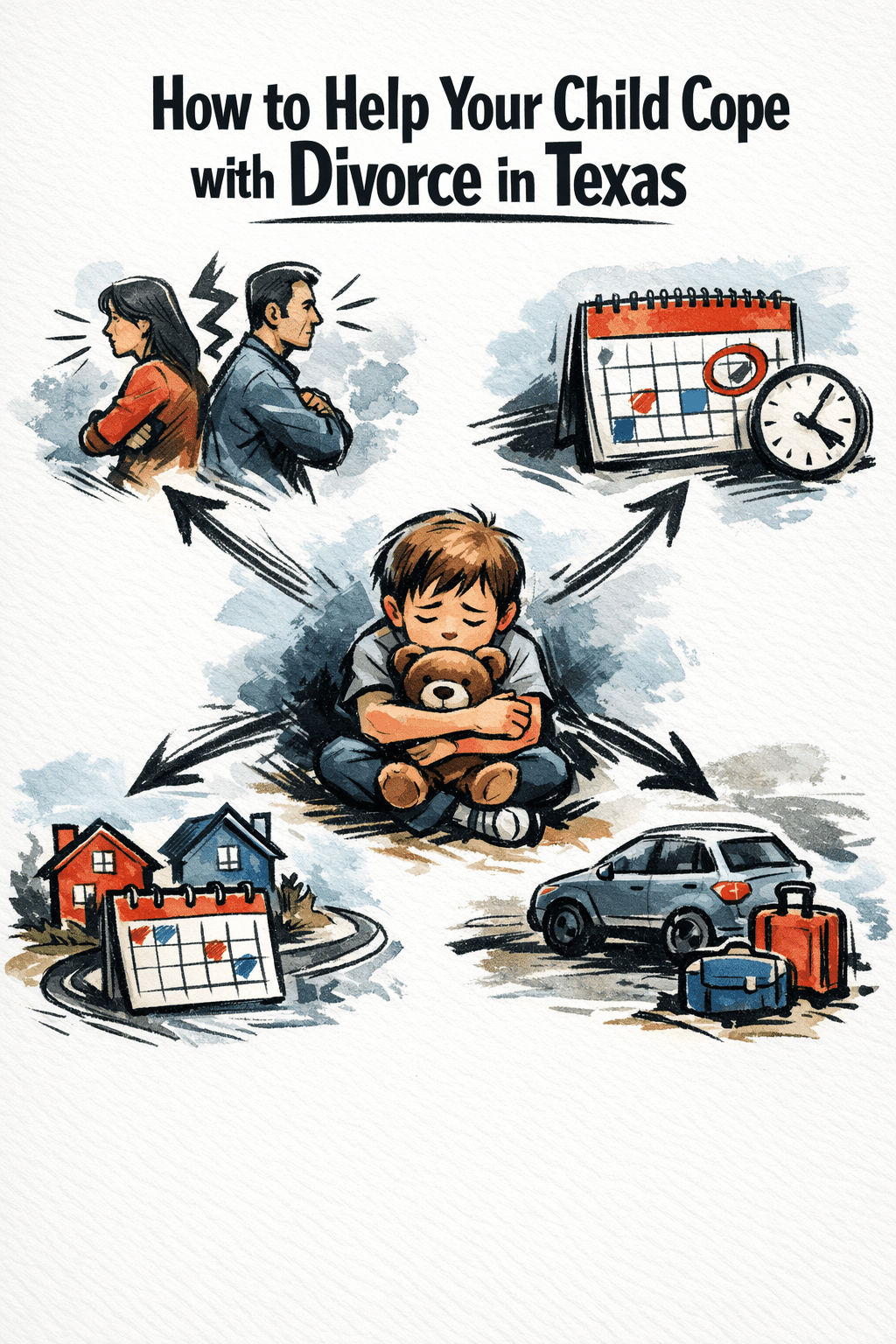
How to help your child cope with divorce in Texas starts with calm, honest talks, a steady routine in both homes, and keeping them out of adult conflict. Plan for exchange days and schedule changes early, because Texas possession schedules can be hardest on kids during transitions.
Quick Answer
Start with one calm, honest message, then build predictable routines across both homes. Keep your child out of adult conflict, especially during exchanges, because changing Texas possession schedules can make transitions the hardest part.
-
Repeat a short script: not your fault, we love you, you’ll see both parents.
-
Use one shared calendar and keep key routines consistent in both homes.
-
Keep exchanges brief and neutral; prep items ahead; keep disputes off the child’s phone.
If you want help building a child-focused plan for your case, call (888) 584-9614 for a free consultation.
Warren & Migliaccio, L.L.P. has helped North Texas families through divorce and child custody matters since 2006. We are Lead Counsel Verified attorneys serving Dallas, Collin, Denton, and Tarrant counties.
Who This Helps vs. Who Needs Something Else
Safety concerns change the playbook, and you should treat them as urgent.
This guidance fits parents who can keep conflict away from the child and follow a predictable routine.
| Best for | Not ideal for |
|---|---|
| Early divorce or separation with manageable conflict | Family violence, stalking, child abuse, or serious safety concerns |
| Parents who can follow a schedule and keep adult issues adult | Active substance abuse that puts the child at risk |
| Can keep conflict away from the child and follow a predictable routine | Safety concerns change the playbook, and you should treat them as urgent |
| This guidance fits parents who can keep conflict away from the child | You may need immediate legal guidance, safety planning, and possibly supervised visitation or protective orders |
In those situations, you may need immediate legal guidance, safety planning, and possibly supervised visitation or protective orders.
Key Definitions (The Consensus View)
In Texas, “custody” is mainly about parental rights and a schedule, not just an address.
When kids can predict what happens next, stress often drops. These terms come up in Texas divorce and custody cases because they shape routines.
| Term | Plain-English Meaning |
|---|---|
| Conservatorship | The legal framework for a parent’s rights and duties (school, medical, major decisions). |
| Possession and access | The parenting-time schedule for each parent. |
| Standard Possession Order (SPO) | A common baseline schedule many Texas courts use in many cases. |
| Temporary orders | Short-term rules while the case is pending. |
| Parenting plan | Written rules for two homes (schedules, decision-making, communication). |
| Co-parenting | How parents coordinate day-to-day parenting across households. |
A “Two-Home Stability Plan” Built Around Texas Possession Schedules
Your child needs steadiness, even if the court schedule is not final yet.
Texas courts decide conservatorship and possession and access based on the child’s best interest. (Tex. Fam. Code § 153.002.) In real life, that often ties to stability, safety, and a parent’s ability to support the child’s relationship with the other parent.
From Our Practice: Making Exchange Days Calmer for Kids

In our North Texas family law work, a pattern we see is that kids often struggle most on exchange days, especially early in a case when parents are still renegotiating week to week. Parents usually come in feeling worried and exhausted, because even a small schedule change can turn into a tense handoff.
When that happens, we focus on creating predictability fast. That can mean pushing for clear temporary orders when needed, and building a simple two-home plan that keeps the child out of adult conflict: one shared calendar, a consistent handoff routine, and a strict no-messenger rule.
The Takeaway: The goal is not a perfect co-parent relationship; it is a predictable week that helps your child feel safe in both homes.
A simple Two-Home Stability Plan:
- Exchange-day script (use the same words each time): “You do not have to choose. You get to love both of us. I’ll see you on the calendar, and we’ll talk tonight.”
- Two-house rules that match: bedtime window, homework routine, screens, and basic discipline so the child’s day feels familiar in both homes.
- One calendar system: one shared calendar for school, medical visits, and activities (plus a kid-friendly version they can see).
- No-messenger rule: the child does not carry messages, money, or schedule disputes between parents.
- Conflict firewall: if a disagreement starts, pause it and move it to a businesslike channel (short, factual, child-focused messages).
- Transition comfort routine: the same backpack system, a small favorite item, or a repeatable “first 10 minutes at the other house” routine.
- Temporary-orders reality check: when schedules are changing, kids often act out more because the week feels uncertain. Predictability is the goal, even if the schedule is not final yet.
- Texas framing in plain English: a steady schedule and a parent who supports the child’s relationship with the other parent can matter when courts look at the child’s best interest.
If you want help building a child-focused plan for your case, call (888) 584-9614 for a free consultation.
Next: Tailor the Plan to Your Child’s Age and Stress Signals
The stability checklist above is the “quick version.” Next, we will walk through common age-based reactions and the short scripts that keep kids out of adult conflict. Then we will build on that with routines, exchange-day habits, and support options so your child feels safe in both homes.
How do kids react to divorce at different ages?
Behavior changes are often a child’s way of saying, “I don’t feel safe yet.”
Many children show stress before they can explain it. Look for patterns, not one bad day.
| Age Group | Common Reactions | What Helps |
|---|---|---|
| Toddlers and preschoolers | Separation anxiety, sleep changes, clinginess | Simple routines, short goodbyes, comfort items, play-based expression |
| School-age children | Worry, anger, “is it my fault,” school stress | Clear scripts, predictable schedules, feelings tools (drawing, charts), teacher support |
| Teens | Withdrawal, acting out, loyalty conflicts, risky behaviors | Respectful talks, privacy with boundaries, counseling options, stable expectations |
If reactions last weeks or worsen, treat that as a signal to add support.
Under Tex. Fam. Code § 153.009, in a nonjury trial or at a hearing, the court must interview a child 12 years old or older in chambers if a party or the child’s court-appointed lawyer (an amicus attorney or attorney ad litem) asks. The child’s wishes are only one factor in the court’s decision.
Age-Appropriate Books That Help Kids Process Divorce in Texas
In our North Texas family law practice, we often recommend children’s books to parents navigating custody schedules and co-parenting plans. These books give kids a safe way to process emotions they might not have words for yet, and they can open doors for conversations that feel hard to start.
When Texas family courts evaluate conservatorship and possession schedules, they consider each parent’s ability to support the child’s relationship with the other parent and help the child adjust. (Tex. Fam. Code § 153.002.) Having age-appropriate tools like these books can be part of your two-home stability plan.
We’ve seen these books help in two ways: they give children permission to talk about feelings, and they give parents a script when their own words fail.
How to use these books effectively:
- Read together, not as homework—sit with your child and let them set the pace
- Ask open-ended questions: “What part made you think of our family?” or “Which character feels like you?”
- Let the child revisit the book when needed (before exchanges, after stressful visits, or when questions come up)
- Consider keeping a copy in both homes when possible, so the resource is consistent
Recommended books by age group:
| Age Range | Book Title & Author | Why It Helps |
|---|---|---|
| 2-4 years | Two Homes by Claire Masurel | Focuses on what is gained (two bedrooms, two sets of favorite things) rather than what is lost. Validates that love exists in both homes. |
| 4-8 years | Dinosaurs Divorce: A Guide for Changing Families by Marc Brown | Uses familiar dinosaur characters to show that divorce is not the child’s fault and that many families go through this. Covers custody schedules and new routines. |
| 4-8 years | I Don’t Want to Talk About It by Jeanie Franz Ransom | Helps kids understand that even when parents disagree, the child will always be loved. Good for kids who withdraw or avoid talking. |
| 9-12 years | It’s Not the End of the World by Judy Blume | Addresses the reality that sometimes, despite best efforts, parents cannot stay together. Helps preteens process the permanence of divorce. |
| 8+ years | Divorce Is Not the End of the World: Zoe’s and Evan’s Coping Guide for Kids by Zoe and Evan Stern | Written by kids who lived through divorce. Shows that kids can grow stronger and learn to handle life changes in positive ways. Good for kids dealing with loyalty conflicts. |
One North Texas client told us her 6-year-old kept returning to Dinosaurs Divorce during the first month after temporary orders—it became his way of processing the schedule changes between Mom’s house and Dad’s house. Another parent said reading Two Homes together before bedtime became part of their goodbye routine on exchange days.
When parents ask us, “How do I explain this without making it worse?” we often suggest starting with one of these books as a conversation opener rather than a formal sit-down talk. The book does the heavy lifting, and the child can ask questions at their own pace.
What should we say to our child about the divorce (and what should we avoid)?
Give one clear message, then repeat it calmly for as long as your child needs.
Children do better with short, steady explanations. Keep the message the same across both homes when possible.
A simple script that works for most kids
- “This is an adult decision. You did not cause it.”
- “We both love you.”
- “You will have time with each of us.”
- “You can ask questions anytime.”
How to answer the hardest questions without oversharing
- “Why?” → “Adults sometimes cannot stay married, but we will both be your parents.”
- “Where will I live?” → “You’ll have a plan, and we’ll show it to you on a calendar.”
- “Do I have to choose?” → “No. You never have to pick. You can love both parents.”
Words that create long-term harm
Do not say these things, even if you feel them:
- Blame: “Your other parent did this.”
- Threats: “If you don’t listen, you won’t see them.”
- Adult details: court strategy, money problems, or relationship betrayal.
- Guilt trips: “After all I do, you still want to go?”
- Interrogations: “What did they say about me?”
How can divorced parents keep routines steady across two homes?
Consistency is a child’s anchor when everything else feels uncertain.
A shared routine matters more than perfect communication.
A practical checklist:
- Same bedtime window in both homes.
- One homework system and one shared school folder.
- Consistent rules for screens and chores.
- A predictable handoff routine (same place and time when possible).
- Keep school stable when possible, and plan carefully if a move or school change is unavoidable.
- Neutral parent communication: short, factual, child-focused.
- Pack the child’s items the same way every time (less last-minute stress).
- Plan meals and mornings so the child is not rushed after exchanges.
How do we keep kids out of conflict and loyalty tests?
The fastest way to reduce anxiety is to remove the child from adult friction.
Children’s long-term exposure to parental conflict can have a lifelong impact on their mental health. A co-parent relationship does not need warmth, but it does need boundaries.
Rules that protect kids:
- No arguing at exchanges. Why it matters: exchanges become the child’s stress trigger.
- No trash talk, sarcasm, or eye-rolling about the other parent. Why it matters: kids feel like half of them is being attacked.
- No using the child to gather information. Why it matters: it makes the child feel responsible for adult problems.
- No asking the child to pick a “side.” Why it matters: loyalty conflicts raise anxiety and guilt.
- Encourage time with the other parent without guilt. Why it matters: kids need permission to love both parents.
Conflict and gatekeeping can hurt the child, and it can also become a custody issue if it shows a parent is not supporting stability.
RELATED: Texas Standard Possession Order — What You Need to Know
How can Texas custody schedules and court orders affect your child?
Texas court orders can stabilize a child’s week, but constant change can raise stress.
Even strong parenting can be undercut by a schedule that keeps shifting.
What “temporary orders” mean for your child’s week
Temporary orders can change pick-up times, school nights, and holidays while the case is pending. For kids, that can feel like the ground keeps moving.
Helpful moves:
- Put the schedule in one shared calendar.
- Tell the child what happens next week, not what might happen someday.
- Keep court talk away from the child.
Texas also has a waiting period before a divorce can be final in most cases. (Tex. Fam. Code § 6.702.) For many families, steady routines matter most during that stretch.
Why exchange days are the hardest moment for many kids
Predictability lowers anxiety. Late arrivals, tense handoffs, and last-minute switches raise it.
What Texas courts focus on when parents are fighting
Texas courts focus on the child’s best interest (Tex. Fam. Code § 153.002). Stability and safety usually matter in how that standard plays out.
Some North Texas courts require parent education classes in certain cases. Confirm what applies in your court.
How do we make exchange days and transitions between homes easier?
A calm, repeatable handoff routine is one of the best gifts you can give your child.
Exchange days should be brief, neutral, and predictable.
Six steps that work:

A kid-friendly two-home calendar helps many families. Use two colors, one per home, so the child can see the week without asking.

When should we get counseling or school support for our child?
If the stress is sticking, professional support can relieve pressure for everyone.
Counseling can give a child a safe place to talk without taking sides.

Based on what you just read about when to get counseling or school support…
Use this quick check to apply the article’s “fits this situation vs. safety concerns” guidance before you keep reading.
Step-by-Step: A 10-Step Plan to Help Your Child Cope During a Texas Divorce
A simple plan creates safety when emotions are running high.
You do not have to guess your way through this.
- Tell the child together if safely possible, so they hear one clear message.
- Use a short, honest script with no adult details.
- Repeat “not your fault” often.
- Keep school and sleep routines steady.
- Build a two-home calendar the child can understand.
- Make exchanges calm and predictable.
- Keep conflict off the child’s ears and off the child’s phone.
- Support the child’s relationship with the other parent, without guilt.
- Track warning signs and talk to the school early.
- If conflict is high, ask about temporary orders, mediation, and child-focused plans.
Mistakes to Avoid (And Bad Advice Online)
If a tip increases guilt, fear, or pressure to choose, it is usually the wrong tip.
Bad advice can make children feel responsible for adult problems.
Myth: “Tell them the whole truth so they understand.” Reality: Adult details can create anxiety and loyalty conflicts.
Myth: “Let the child decide which parent is right.” Reality: Kids need permission to love both parents.
Myth: “If we don’t yell, arguing is fine.” Reality: Tension still harms mental health over time.
Myth: “Use the child to coordinate schedules.” Reality: It makes the child feel responsible for adult problems.
Myth: “Last-minute schedule changes are no big deal.” Reality: Unpredictability is a major stress trigger for many kids.
Many parents describe exchange-day stress and the value of keeping routines predictable, even in public custody discussions like this thread: https://www.reddit.com/r/Custody/comments/1ol3p9h/tx_beginning_divorce_process_with_18mo_old/
If you are going through divorce in North Texas and want a child-focused plan for conservatorship and parenting time, call (888) 584-9614 for a free consultation.
Frequently Asked Questions About Helping Your Child Cope With Divorce in Texas
Getting Started: What to Say and How to Support Your Child
How do I help my child through a divorce?
-
Tell them together when it is safe, and repeat: not your fault, we love you.
-
Keep adult conflict away from them, especially during exchanges and transitions.
-
Use one shared calendar and matching routines in both homes.
-
Get school or professional support if distress lasts weeks or worsens.
Helping your child cope is less about one perfect talk and more about the daily rhythm you protect. Many families see schedules shift early, including during the 60-day waiting period in many cases (Tex. Fam. Code § 6.702). Texas courts apply the best interest standard (Tex. Fam. Code § 153.002), and judges expect parents to keep kids out of conflict.
What should I say when I first tell my child we’re getting divorced in Texas?
Keep it short and repeat these messages often:
This is an adult decision; you did not cause it.
We both love you, and you can love both parents.
You will have a schedule; we will show it to you on a calendar.
You can ask questions anytime; you do not have to choose.
We will not talk to you about court, money, or adult problems.
Aim for clarity, not explanations. Use age-appropriate terms and keep the focus on what stays the same: love, routines, school, and time with each parent. A common mistake is turning the divorce into a story about who is “right,” which pulls children into loyalty conflicts.
Is therapy worth it for my child during a Texas divorce?
Yes. Counseling can help when distress lasts weeks, school or sleep suffers, or self-harm talk appears. It can give a child a safe place to talk without taking sides.
Not every child needs therapy, and starting with the school counselor can be enough for some families. What matters is whether symptoms persist or grow, such as disturbed sleep, school refusal, or significant behavior trouble. A practical tip is to keep therapy out of the custody dispute and avoid turning sessions into evidence-gathering.
Long-Term Effects and the Child’s Age
How does divorce affect a child in the long run?
In the long run, children do best when conflict stays low and routines stay steady. Ongoing fighting can drive anxiety, behavior problems, and strained future relationships.
The long-run risk is often less about two homes and more about ongoing parental conflict and instability. In Texas cases, the guiding standard is the child’s best interest (Tex. Fam. Code § 153.002), which often lines up with stability: consistent routines, calm exchanges, and parents who keep adult issues separate.
What is the hardest age for a child to deal with divorce?
There is not one hardest age. School-age kids often feel guilt and blame, teens can face loyalty conflicts, and toddlers may struggle with separation anxiety. The toughest stage is often when conflict is high.
Different ages need different supports. Younger children understand divorce through routines, while older kids may need repeated reassurance and stable expectations. For older kids, Texas law allows judges to interview a child 12 or older in some cases (Tex. Fam. Code § 153.009), but that should never become a “vote.”
Texas Custody Schedules, Exchanges, and Mediation
Can my child choose which parent to live with in Texas?
No. Children do not “choose custody” in Texas. Texas custody decisions are made under the best interest standard (Tex. Fam. Code § 153.002).
Under Tex. Fam. Code § 153.009, in a nonjury trial or at a hearing, the court must interview a child 12 or older in chambers if a party or the child’s court-appointed lawyer asks. The child’s wishes are only one factor, and parents should avoid coaching or “campaigning.”
How do I make custody exchanges easier for my child in Texas?
Pick a calm exchange location and keep handoffs brief and neutral.
Use the same goodbye and hello routine every time.
Prepare the child’s items ahead of time to avoid last-minute conflict.
Keep adult disagreements off-site and off the child’s phone.
Build decompression time after exchanges (snack, shower, quiet activity).
Exchange days are where kids cope with the change most, so the goal is predictability. When the schedule is shifting, put the next two weeks on one calendar and stick to it. If your child comes home angry or sad after handoffs, respond with a safe space, not questions about the other home.
Is mediation worth it for a child custody schedule in Texas?
Yes. Mediation is often worth it when communication is safe. It can produce a workable schedule and reduce conflict that harms children.
Mediation can be a good fit when one or both parents can communicate safely and stay child-focused. It is usually not a good fit when there are safety concerns like family violence or stalking, or when one parent uses the process to keep renegotiating. In those situations, clear temporary orders and a predictable schedule may be necessary, including during the 60-day waiting period in many cases (Tex. Fam. Code § 6.702).
Texas Statutes That Apply
These Texas Family Code provisions influence schedules and the stability kids experience.
Texas statutes do not tell you exactly what to say to your child, but they shape schedules and what courts expect from parents.
Texas Authority | What It Governs | Why It Matters to Your Child |
|---|---|---|
Stability and safety often connect to conflict levels and routines. | ||
Texas Family Code (Standard Possession Order provisions) | Baseline parenting-time schedule in many cases | Predictability can help, especially around exchanges and school nights. |
Sets expectations for how long uncertainty may last. | ||
Child interview by judge in certain cases | Helps parents understand how a child’s wishes may be considered. |
Legal Authorities
This article is for informational purposes only and does not create an attorney-client relationship.
- Tex. Fam. Code § 153.002 (Best interest of the child)
- Tex. Fam. Code § 6.702 (60-day waiting period)
- Tex. Fam. Code § 153.009 (Child interview by judge in certain cases)
- Texas Family Code (Standard Possession Order provisions)
Talk With a North Texas Family Law Attorney About a Child-Focused Plan
Divorce and custody changes can feel hardest on kids during the handoffs and schedule shifts. Our attorneys at Warren & Migliaccio help North Texas families build clear structure around the hard parts, including steadier routines in two homes, calmer exchanges, and boundaries that keep your child out of adult conflict. If you want practical next steps for your situation, call (888) 584-9614 for a free consultation.


