
Wondering what “legal guardian vs power of attorney in Texas” really means?
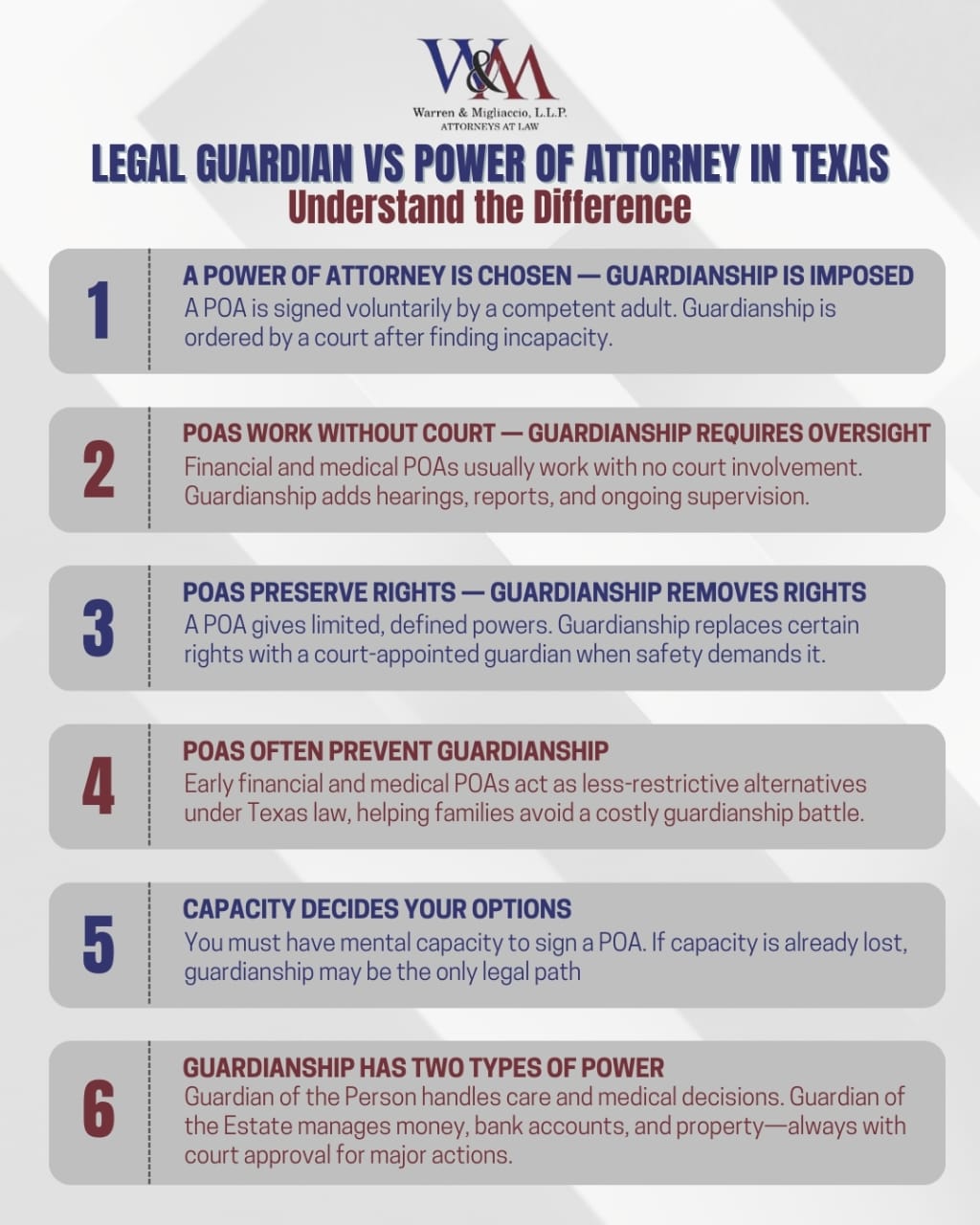
A power of attorney in Texas is a private legal document. In it, a capable adult chooses an agent (attorney-in-fact) to handle financial or medical decisions. Meanwhile, a legal guardian is very different. It is a court-appointed role that starts only after a judge finds someone incapacitated.
The judge then removes some of that person’s rights under the Texas Estates Code. Because of this, planning ahead with the right powers of attorney is important. It can help you avoid a costly and restrictive guardianship of the person. It also keeps decision-making within the family.
Key Takeaways
- • Drafting financial and medical powers of attorney early keeps decision-making in trusted family hands.
- • Guardianship is a last-resort court process that removes rights and adds ongoing judicial oversight.
- • Texas courts must consider less-restrictive alternatives—like POAs and supported decision-making—before ordering guardianship.
- • A coordinated plan using POAs, advance directives, and beneficiary designations can spare families costly court battles.
What key facts should Texans know about guardianship and power of attorney?
Texans should know that a power of attorney (POA) is chosen and customized by the individual. Guardianship, on the other hand, is imposed by a court. It removes rights and requires ongoing court oversight and reporting.

Both are legal tools used in estate planning and elder law. They help manage financial matters, medical treatment, and personal care when someone cannot safely handle their own affairs.
Comparison Table – Power of Attorney vs Types of Guardianship in Texas
| Factor | Power of Attorney in Texas | Legal Guardianship in Texas | Key Texas Law / Notes |
|---|---|---|---|
| Who chooses? | A competent adult (the principal) chooses and appoints an agent or attorney-in-fact in a private document. | A Texas court appoints a guardian after someone files an application and incapacity is proven. | Estates Code chs. 751–752 (POA); ch. 1101 (guardianship applications). |
| When it starts? | Usually effective when signed, or later if drafted as a “springing” power that starts on incapacity. | Begins only after a judicial finding that the person is incapacitated and a guardian is formally appointed. | Capacity rules and timing discussed in Texas POA and guardianship statutes. |
| Court intervention? | Generally no routine court involvement; banks and providers rely on the signed POA document. | Formal court proceeding, possible bond, and ongoing court oversight with required reports and accountings. | Estates Code chs. 1101–1105, 1151, 1163 (guardianship procedures and oversight). |
| Scope of authority | Only the specific financial, medical, or other powers the principal grants in the POA document. | Court removes certain rights from the person and transfers those rights to the guardian as ordered. | Guardianship orders define the guardian’s authority under the Estates Code. |
| Time & cost | Typically prepared and signed in one or a few attorney office visits plus notarization fees. | Time-consuming court process with filings, evaluations, hearings, bond premiums, and ongoing legal and court costs. | Described in guardianship provisions and legal guidance from Texas elder-law resources. |
We offer free consultations across Texas at (888) 584-9614 if you’re unsure which route fits your family.
How does a Texas power of attorney actually work for your money and medical care?
A Texas power of attorney works by giving a trusted agent legal authority to act for you. This agent can pay bills, manage bank accounts, and make medical decisions if you cannot speak for yourself. Often, this can be done without any court involvement.
What types of powers of attorney are most common in Texas estate planning?
The most common Texas POAs are written legal documents. A competent adult (the principal) designates an agent or attorney-in-fact to handle clearly defined tasks.
In estate planning and elder law, we typically recommend:
- Statutory durable (financial) power of attorney. It lets your agent manage bank accounts, retirement accounts, real estate, and ongoing expenses such as mortgage, taxes. It uses the Texas Estates Code durable power of attorney forms, which banks and financial institutions recognize easily.
- Medical power of attorney / healthcare power of attorney. It authorizes a trusted person to make healthcare decisions with your doctors if you cannot communicate. It often works alongside living wills and other advance directives under Texas Health & Safety Code Chapter 166.
- Limited or specific POAs. It is used for particular tasks, such as closing a single real estate deal or handling a specific lawsuit, rather than giving broad authority.
With a strong financial POA and medical POA, your agent can handle money and medical matters as the document allows. This often prevents family members and the loved ones from having to pursue guardianship later. These tools are essential in elder law. They protect vulnerable people while respecting their wishes.
Related Guide: Step-by-Step Guide: Creating a Valid Texas POA for Your Senior Parent
When does a Texas power of attorney take effect and end?
A Texas power of attorney takes effect when the document says it does and ends when it’s revoked, replaced, or automatically terminated under Texas law.
Key timing rules:
- Mental capacity to sign: You must understand, in a basic way, what property you have, who you trust, and what authority you’re giving. If you already lack mental capacity, you can’t validly sign a POA and guardianship may be the only option.
- Immediate vs. springing:
- Immediate POA – your agent’s decision‑making power starts as soon as you sign.
- Springing POA – your agent’s authority “springs” into effect only after a doctor (or two) certifies you’re incapacitated, as defined in the document.
- Durable power: A durable power of attorney remains effective even if you later become incapacitated, as long as it uses required durability language or the statutory form.
- When it ends: A POA generally ends if you revoke it, if you die, and sometimes if you divorce the agent‑spouse or if a court later appoints a guardian and terminates the agent’s authority.
Done early, POAs let you plan ahead, keep control of your own life while you are competent, and greatly reduce the need for future court intervention.
How can a power of attorney help your family avoid guardianship later?
A well‑drafted financial POA and medical power of attorney can serve as strong “less restrictive alternatives” to guardianship under Texas law, allowing an agent to manage financial matters and healthcare decisions without a lawsuit.
I often tell clients that a Power of Attorney is their ‘insurance policy’ against the probate court. When drafted correctly, it keeps your family out of the courtroom entirely. Without it, you are left with Guardianship—a process where a judge, not your family, has the final say over your loved one’s money and freedom. In my experience, families who rely on guardianship often face months of delays and legal bills that could have been avoided with a simple document signed while Mom or Dad was still healthy
When does a Texas court appoint a legal guardian instead of relying on a power of attorney?
Texas courts appoint a legal guardian only after finding that a person is incapacitated and that less restrictive options—like POAs or supported decision‑making agreements—will not adequately protect the person’s care or property.

How do Texas guardianship proceedings work from petition to court hearing?
Texas guardianship proceedings start when someone files an application in a court that has jurisdiction and venue over the proposed ward.
In a typical adult guardianship case:
- An interested family member or other person files an application asking the court to appoint a guardian of the person, estate, or both.
- The court appoints an attorney ad litem and often a court investigator or visitor to review records, interview the proposed ward, and look at possible less restrictive alternatives such as POAs or supported decision‑making agreements.
- Medical professionals evaluate mental capacity and prepare a certificate or report.
- A court hearing is set where the judge determines whether clear and convincing evidence shows incapacity and that alternatives won’t work.
- If the judge grants guardianship, the court appoints a guardian, issues letters of guardianship, and may require a bond.
These court proceedings are formal, time consuming, and can be emotionally and financially taxing for the whole family.
What decision-making powers does a guardian have over an adult’s personal care and finances?
A Texas guardian’s powers are defined by court order and the Estates Code, and they usually fall into “guardian of the person” and “guardian of the estate.”
- Guardian of the person – manages the person’s care:
- Living arrangements and residential placement.
- Day‑to‑day personal care, safety, and support services.
- Health care decisions with physicians and other healthcare providers.
- Guardian of the estate – manages financial matters:
- Receiving income, handling bank accounts, paying bills and ongoing expenses.
- Protecting assets, dealing with creditors, and managing investments.
Because guardianship removes certain rights from the individual, the guardian must act in the ward’s best interests and is subject to strict court involvement:
- Annual or periodic regular reports and accountings to the court.
- Court approval required for major transactions such as selling real estate or large expenditures.
Guardianship is significantly more restrictive than a POA and should be tailored to remove only the rights necessary to protect the vulnerable person.

What are supported decision-making agreements and other less-restrictive options in Texas?
Supported decision-making agreements let adults with disabilities pick a supporter. The supporter helps them gather information, weigh choices, and make their own decisions. It does not give anyone else legal control.
Texas law views supported decision-making, POAs, and similar tools as ways to protect independence. Courts must consider these options before imposing guardianship.
Case Study: Avoiding a Texas Guardianship Battle with Powers of Attorney

Problem: We were contacted by an adult son whose father in North Texas was showing mild memory loss. The family worried that a sudden health crisis could leave them unable to consent to treatment or pay essential bills if banks froze accounts or doctors demanded formal authority. They wanted to protect his dignity and independence but feared an expensive, restrictive guardianship fight down the road.
Action: While the father still had legal capacity, we carefully evaluated his specific situation, both medical and financial picture. We then drafted a customized statutory durable financial power of attorney and a medical power of attorney under the Texas Estates Code and Health & Safety Code, clearly outlining the son’s authority over banking, real estate, and healthcare decisions as a less-restrictive alternative to guardianship.
Result: Six months later, the father was hospitalized unexpectedly. Because the signed POAs were already in place, the son immediately provided them to the hospital and the bank, authorized necessary treatment, kept utilities and prescriptions paid, and arranged safe home care. No guardianship petition, court hearing, bond, or ongoing reporting was required.
Takeaway: Planning early with Texas-compliant financial and medical powers of attorney can keep decision-making in trusted family hands, protect an elder’s autonomy, and often eliminate the need for a costly, stressful guardianship proceeding.
What step-by-step process should you follow to choose between power of attorney and guardianship in Texas?
You should follow a simple, structured process that starts with evaluating capacity and less restrictive tools, and only then looks at guardianship as a back-up.
-
1.
Clarify the person’s current mental capacity.
Ask: Can they understand a legal document, recognize their property and legal relationships, and make informed choices? If yes, POAs and other tools are usually preferable. -
2.
List the decisions that need coverage.
Identify the specific financial decisions, medical treatment, living arrangements, and personal care issues that must be addressed. - 3. Plan ahead with less restrictive tools first.
- 4. Draft and sign a financial POA and medical power of attorney tailored to the needed specific powers (money management, healthcare decisions, etc.).
- 5. Consider HIPAA releases, beneficiary designations, and supported decision-making agreements to reinforce autonomy.
-
6.
Talk with a Texas elder law / estate planning attorney.
An attorney can explain how Texas Estates Code rules apply, help you avoid common pitfalls with DIY forms, and guide you if abuse, exploitation, or serious legal disputes are present. -
7.
Consider guardianship only in certain circumstances.
Guardianship becomes appropriate if the person already lacks capacity to sign anything, is being financially exploited, or refuses needed care and less-restrictive options won’t work. -
8.
Review and update documents.
Revisit POAs, supported decision-making arrangements, and related documents as health conditions, marriages, or family dynamics change.
We’ve helped Texans across the state protect what matters most with solid estate planning, drawing on 20 plus years experience and Lead Counsel Verified attorneys in matters that often overlap with divorce, custody, and bankruptcy issues. We offer free consultations statewide at (888) 584-9614 so you can understand your options before a crisis.
Which Texas laws and cases govern guardianship and powers of attorney – and why do they matter to you?
Texas statutes and cases give the rules for POAs, guardianship, and less restrictive alternatives, and they explain when courts can remove rights or must honor your planning.
- Texas Estates Code chs. 751–752 (Durable Financial Power of Attorney).
Why it matters: Sets the requirements for a valid durable power of attorney and the agent’s authority, making it more likely that banks and financial institutions will honor your financial POA. - Texas Health & Safety Code ch. 166 and related Estates Code provisions (Medical POA & Advance Directives).
Why it matters: Controls medical powers of attorney, living wills, and end-of-life care directives so healthcare providers know who can make healthcare decisions and what treatment you want. - Texas Estates Code chs. 1101–1105, 1151, 1163 (Guardianship).
Why it matters: Governs guardianship proceedings, findings of incapacity, the guardian’s decision-making authority, required regular annual reports, and the court oversight that makes guardianship more restrictive and costly. - Texas Estates Code §1002.0015 & ch. 1357 (Alternatives and Supported Decision-Making Agreements).
Why it matters: Courts must consider less-restrictive options—like POAs and supported decision-making agreements—before ordering guardianship, preserving individual autonomy whenever possible. - Key Texas appellate decisions on guardianship and alternatives.
Why it matters: Cases like In re Thetford and In the Guardianship of N.P. show that courts scrutinize guardianships, look for less-restrictive alternatives, and examine whether a person can still execute a POA or supported decision-making agreement.
For a comprehensive overview of essential estate planning documents, see this guide.
What common myths about legal guardians and powers of attorney in Texas could hurt your family?
Several persistent myths about guardianship and power of attorney in Texas can lead families into unnecessary risk, delay, or expense.
- Myth 1: “We can wait until Mom has dementia to sign a power of attorney.”
Reality: Texas law requires sufficient mental capacity to sign a POA; once capacity is gone, a court may only be able to help through guardianship. - Myth 2: “A power of attorney lets my agent take my money and override my wishes.”
Reality: Agents are fiduciaries with legal duties to act in your best interests, can be limited to specific tasks, and can be replaced or prosecuted if they abuse their authority. - Myth 3: “Guardianship is easier than arguing with the bank about a POA.”
Reality: Guardianship is more expensive, more time consuming, and more restrictive; it removes rights, requires court approval, and involves ongoing accountings and reports. - Myth 4: “Any generic online form will work in Texas.”
Reality: Texas has detailed statutory language and execution requirements; improper forms can be rejected by banks or hospitals and lead straight to legal disputes or guardianship filings.
Frequently Asked Questions
Guardianship vs Power of Attorney
Does a power of attorney override a legal guardian in Texas?
Usually, no. If a court later appoints a guardian, it can limit or terminate the agent’s authority so the guardian’s decisions under court supervision take precedence.
Can my agent under a power of attorney later be appointed as my guardian?
Yes. Courts frequently appoint the same trusted family member as guardian if guardianship becomes necessary, but the court still makes an independent “best interest” decision.
Healthcare Decisions
Do I need both a medical power of attorney and a living will?
Often yes. A medical POA names a decision-maker; a directive to physicians (living will) states your wishes about life-sustaining treatment. Together they guide healthcare providers and your family.
Costs and Agents
How much does guardianship usually cost compared to signing powers of attorney?
There is a massive difference in cost. A POA package might cost a few hundred to a few thousand dollars depending on complexity. In contrast, a contested guardianship in Texas often starts at $5,000–$10,000+ due to the requirement of two attorneys (the applicant’s attorney + the court-appointed attorney ad litem).
Can I name more than one family member as my agent?
Yes, you can name co-agents or successor agents, but co-agents should be chosen carefully to avoid conflict and confusion for banks and doctors.
Disagreements and Conflicts
What happens if family members disagree with the agent’s decisions?
They may first try mediation or counseling; in serious cases, they can ask a court to review the agent’s conduct, seek removal, or—if no alternative works—request guardianship.
Key Takeaway About Legal Guardian vs Power of Attorney in Texas
Plan early. Use powers of attorney and other less restrictive tools whenever possible. Keep guardianship as a last resort, only when safety truly requires court involvement.
Call our law office at (888) 584-9614 or contact us online for a free consultation about Texas estate planning and elder law.
Where can you read the Texas laws and resources we’ve mentioned? (Legal Authorities / Endnotes)
- Texas Estates Code chs. 751–752. Durable Power of Attorney Act (statutory durable powers of attorney, agent’s authority, execution, and durability).
- Texas Health & Safety Code ch. 166. Texas Advance Directives Act (medical powers of attorney, directives to physicians, and related end‑of‑life documents).
- Texas Estates Code chs. 1101–1105, 1151, 1163 & related guardianship provisions – Applications, findings of incapacity, guardian’s powers and duties, bonds, and accountings.
- Texas Estates Code §1002.0015 & ch. 1357. Alternatives to guardianship and Supported Decision‑Making Agreement Act (formal less‑restrictive options courts must consider).
- Selected Texas appellate cases on guardianship and alternatives. Including In re Thetford, 574 S.W.3d 362 (Tex. 2019); In the Guardianship of N.P., 2020 WL 7252322 (Tex. App.—Fort Worth 2020); and Texas Supreme Court and court of appeals opinions discussing powers of attorney, less‑restrictive alternatives, and supported decision‑making.
- Texas Judicial Branch & county law library resources. They include guardianship guides, forms, and checklists available through county probate courts.
Call (888) 584-9614 or contact us online to schedule a free consultation with our team of Dallas, Texas estate planning attorneys.