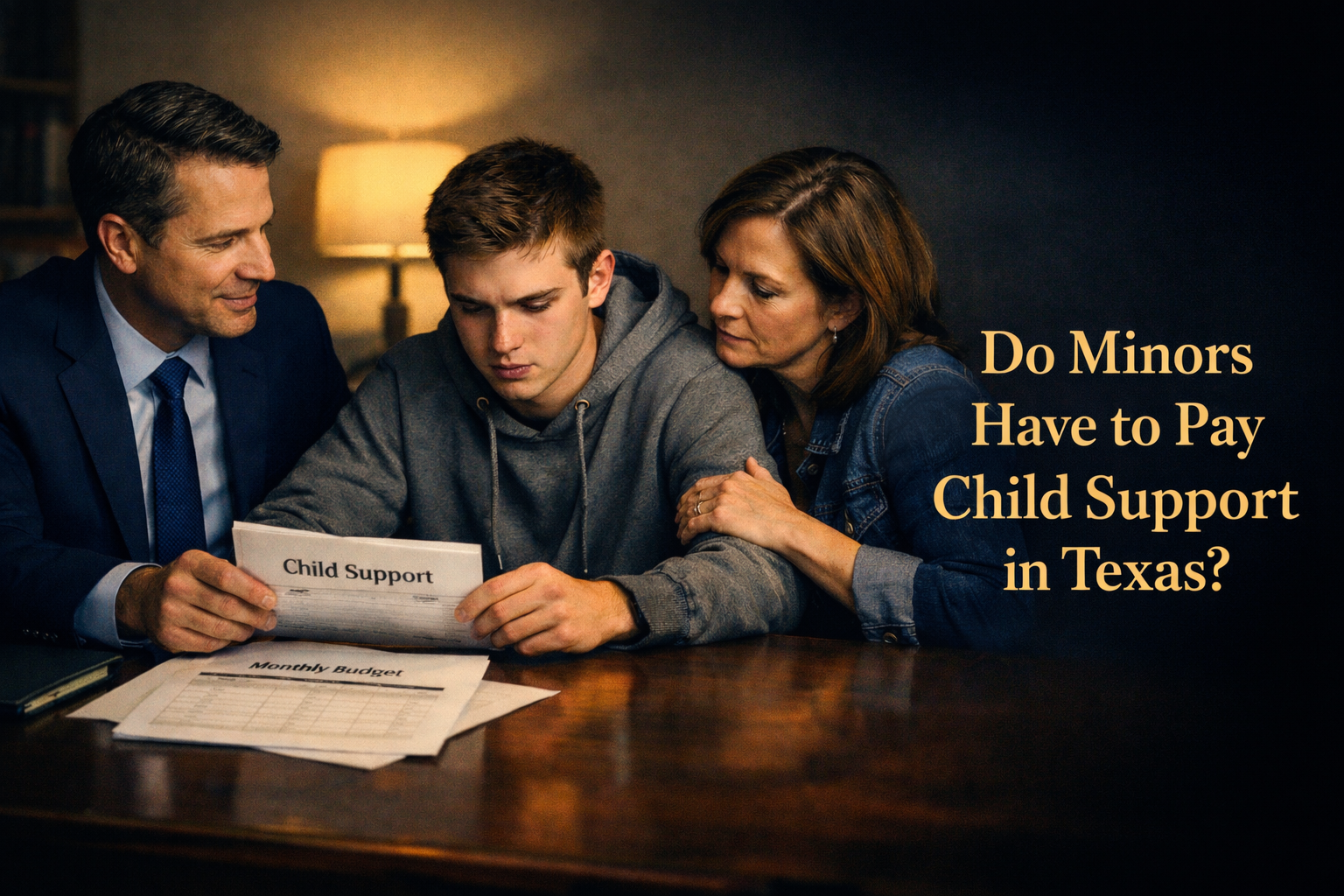
Do minors have to pay child support in Texas? Yes. In Texas, a parent can be ordered to pay child support even if that parent is under 18. But minor-parent cases often need an adult next friend to help the teen parent take part in court.
Key Takeaways
Even if a parent is under 18, Texas can still order child support, and the case may require an adult “next friend” so the teen parent can participate in court.
- A parent under 18 can still be ordered to pay child support.
- Support usually ends at 18 or high school graduation, whichever is later.
- The Texas OAG Child Support Division can help set up and enforce support.
- Not working does not automatically mean $0 support for a minor parent.
- Ignoring the case can lead to arrears, wage withholding, and license suspension.
Micro-definitions (plain English):
- Child support: money paid to help cover a child’s basic needs, including medical support and often dental insurance.
- Court order: a judge-signed order that creates and enforces the support obligation.
- Next friend: an adult who helps protect a minor parent’s legal rights in the case.
Quick reality checks:
- Not working does not automatically mean $0 support.
- Ignoring the case is how arrears build.
Key Facts for Minors and Child Support in Texas
| Quick fact: What You Should Know About Child Support | What it means in real life |
|---|---|
| “Minor parent” | A parent under 18 can still be an obligor (the person who pays support). |
| “Minor child” | The child receiving support is usually under 18, and the support end date follows Texas rules. |
| Agency involved | The Texas OAG Child Support Division can help set up and enforce support. |
| Key deadline concept | Support typically ends at 18 or high school graduation, whichever is later, unless an exception applies. |
| Risk markers | No court order, unpaid support, growing arrears, wage withholding, license suspension, contempt risk. |
How does Texas child support work when someone is a minor?
The basic steps are usually the same as adult cases. Texas ties child support to being a legal parent, not to turning 18.

In practical terms, most cases follow this path regarding the basic costs of child support in Texas:
- Confirm legal parenthood (or establish it if it is disputed).
- Get a child support order signed by a judge.
- Make support payments through the state system as required.
- Respond quickly if enforcement notices arrive or if circumstances change.
Which “minor” are you asking about?
| Path A: “I am under 18 and I am the parent.” | Path B: “My under-18 child had a baby.” |
|---|---|
| Bottom line: A court can still order you to pay child support. | Bottom line: Grandparents are not automatically ordered to pay support for a grandchild. |
| Not specified in the article | Custody and support facts can get complicated if you take over care. |
Bottom line: Grandparents are not automatically ordered to pay support for a grandchild, but custody and support facts can get complicated if you take over care.
Can a minor parent be ordered to pay child support in Texas?
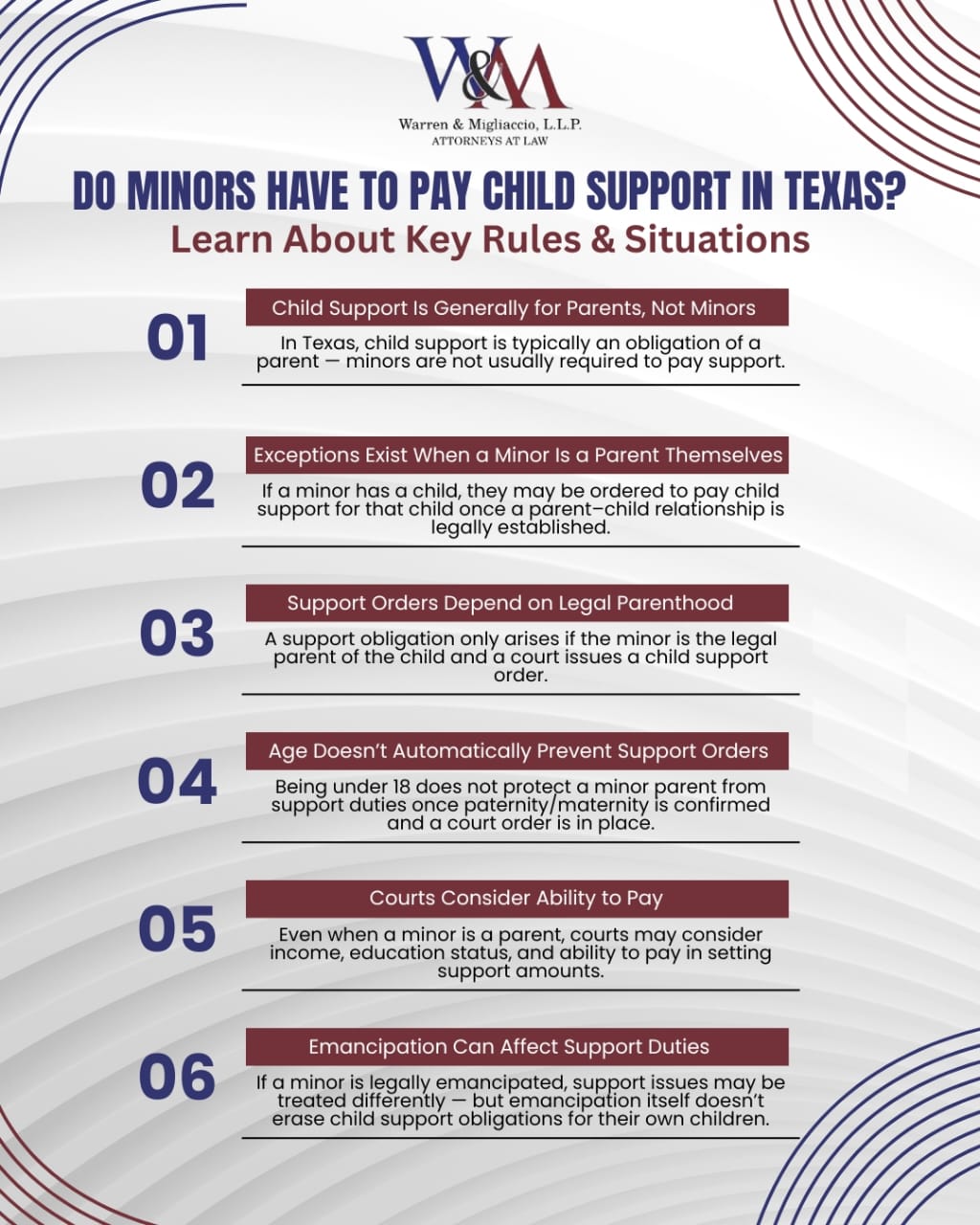
Yes, a minor parent can be ordered to pay child support in Texas. Child support is tied to being a legal parent, not to turning 18.
If paternity is disputed, the case often starts by establishing the parent-child relationship. Once legal parenthood is established, the court can issue a child support order and set support payments.
Related Guides:
- Child Custody Lawyer Denton County for Families
- How is Child Support Determined?
- Child Support Modifications & Enforcements
- How to File for Divorce in Collin County Guide
For more on custody issues that often connect to child support, see: Child Custody
How do Texas judges handle child support if the minor parent has little or no income?
Judges usually base support on the minor parent’s real income, but “no job” does not always mean $0. Courts look at net resources like pay stubs from part-time work, self-employment income, and other income sources when they apply the guideline rules.

Common examples of income courts may consider:
- Pay stubs from part-time work
- Self-employment income
- Other income sources shown in records
For more information on what happens if an ex is not paying child support, see how family law lawyers can help enforce payments.
If the teen is in school, the court may still order support, but the amount may reflect:
- Limited hours and lower wages
- Whether the teen receives help from family
- Whether the teen is choosing not to work when they reasonably could (intentional underemployment can become an issue)
Reality check: Not working does not automatically mean $0 support.
Another reality check: Ignoring the case is how arrears build. The OAG can enforce unpaid support, including license suspension in some situations.
What is a “next friend,” and why does it matter in minor-parent cases?
A “next friend” is an adult who helps a minor parent participate in the case and protect their legal rights. Under Texas procedure, minors may appear through a next friend in court matters.
A next friend often:
- Attends hearings and conferences with the minor parent
- Helps the teen understand what the judge is deciding
- Helps gather documents and keep the teen on track
A next friend does not:
- Automatically become responsible for the teen’s child support payments
- Replace a lawyer or give legal advice unless they are also child support attorney
If you are dealing with a teen-parent child support case in North Texas and you want help getting the facts in front of the judge clearly, call (888) 584-9614 for a free consultation with Warren & Migliaccio, L.L.P.
When does child support end in Texas?
| Category | What the article says |
|---|---|
| Standard end date | 18 or high school graduation, whichever is later |
| Early end triggers (certain circumstances) |
|
| Exception that can extend support | Support may continue past 18 if the child has a qualifying physical or mental disability and requires substantial care. |
| Practical warnings |
|
In most situations, child support ends when the child turns 18 or graduates from high school, whichever is later. Use this checklist as a quick guide:
What about medical and dental support in Texas child support orders?
Texas child support orders often include medical and dental support on top of base support. Courts may require:

- Health insurance coverage if available at a reasonable cost
- Dental insurance if available
- Reimbursement rules for uninsured expenses (often split by percentage)
- Cash medical support in some cases
This is one reason I caution families about informal “side agreements.” If a judge signs an order, the order controls.
Related Guide: Does Paying Health Insurance Reduce Child Support in Texas?
A Personal Story from the Family Law Attorney Migliaccio
Recently, I met with a 17-year-old dad who looked terrified before his first child support hearing. He worked weekends at a grocery store and was still in high school. His biggest fear was jail time, and he thought being a minor meant the judge could not order support. I explained that Texas courts can still enter a child support order, and that ignoring the case is how arrears grow fast. We brought his mother as his next friend, gathered pay stubs, and showed his class schedule.
The judge set support based on his real income and included medical and dental insurance terms he could follow. When he left my office, he said he could finally breathe. Over my nearly 20 years practicing law, I have learned that a realistic plan beats panic. Every family can find a path forward.
How did a North Texas teen parent get a workable child support order?
Case Study: Securing a Workable Child Support Order for a Teen Parent

Problem: A 17-year-old father in Denton County came to us before his first child support hearing. He was in high school, worked weekends at a grocery store, and was scared that missed payments meant jail, especially after the other side pushed for $400 a month.
Action: We explained that Texas ties support to legal parenthood, not age, and brought his mother as his “next friend” so he could participate. We gathered pay stubs and his school schedule, calculated guideline support from his net resources, and presented a workable plan that included medical and dental terms.
Result: The judge set support based on his actual income, reducing the proposal from $400 to $185, and kept arrears under $500. He left with clear steps to stay current and avoid enforcement.
Takeaway: A realistic order beats panic. If you are a teen parent, do not ignore court papers. Bring a next friend, show real income, and get an order you can follow. Outcomes depend on the facts and the court.
How do we handle a minors-and-child-support case step by step in North Texas?
We follow a simple court-ready plan that keeps the case from turning into an arrears problem.

1st Step: Identify the situation and the goal
Minor parent paying support, grandparent worried about liability, or “when does child support end.”
2nd Step: Confirm legal parenthood
Acknowledgment of paternity or the court process if disputed.
3rd Step: Gather the right documents before court
Pay stubs, proof of school enrollment, childcare costs, and health and dental insurance info.
4th Step: Get the right case pathway
Divorce with kids, a SAPCR (custody case), or an OAG child support case. (Related: Divorce)
5th Step: Build a realistic support proposal
Guideline support baseline, medical and dental support, and a plan to avoid arrears.
6th Step: Do not ignore enforcement notices
If circumstances change, a modification is often better than falling behind.
If you want help putting that plan into action in Dallas, Collin, Denton, or Tarrant County, call (888) 584-9614 for a free consultation.
What Texas statutes and court rules control child support for minors?
Here is a short map of the main authorities discussed in this article, using a format that is easier to scan.
| Authority | What it governs | Why it matters |
|---|---|---|
| Texas Family Code Chapter 154 | Guidelines and framework | Tells the judge how to calculate support and include medical support. |
| Tex. Fam. Code § 154.001 discusses the legal framework regarding child support agreements in Texas. | Duty to support and common duration rules | Answers “when does it end” and ties the end date to age 18 or high school graduation. |
| Tex. Fam. Code § 154.125 | Guideline percentages based on net resources | Sets the usual starting point for the monthly amount. |
| Tex. Fam. Code § 154.006 | Termination of duty of support | Lists events that can end the support order, including marriage and military service. |
| Tex. Fam. Code § 154.302 | Support past 18 for disabled child – learn about the | Allows support to continue for a child with a qualifying disability who needs substantial care. |
| Texas Family Code Chapter 31 | Removal of disabilities of minority (emancipation) | A legal status change can affect how courts treat a “minor” in certain steps. |
| Tex. R. Civ. P. 44 | Next friend concept | A teen parent may need an adult helper to protect legal rights in court. |
| Texas Family Code Chapter 157 | Enforcement of child support | Covers enforcement tools and consequences when support is not paid. |
| Tex. Fam. Code § 102.003 | Standing to file a SAPCR | Explains who can file a parent-child relationship case. |
What mistakes do people make after reading bad internet advice about minor child support?
| Myth | What the article says is true |
|---|---|
| If I’m under 18, a judge can’t order me to pay child support. | Under Texas law, support is based on parenthood, not age. |
| If I’m in high school, child support is automatically $0. | School affects income facts, but it does not erase the obligation. |
| Grandparents automatically have to pay for the grandchild. | That is not automatic. Legal parenthood matters, and facts control. |
| Child support stops the day the child turns 18 no matter what. | It may last until high school graduation, and disability support can continue in limited cases. |
| I can just pay cash directly and it will count the same as official payments. | Untracked payments can create a fight later. |
Most problems start when people believe myths and stop taking court papers seriously.
Two warnings I give families:
- Uncredited payments can still leave you owing arrears.
- A court order controls, not verbal promises.
Frequently Asked Questions
Teen Parents and Court Representation
Can a minor parent be ordered to pay child support in Texas, and who represents them in court?
Yes. In Texas, a court can order child support from a parent who is under 18. This is because child support is based on legal parenthood, not age. In other words, if someone is legally recognized as a parent, the court can require them to provide financial support for their child, even if they are still a minor.
That said, because minors usually cannot sign certain court documents or fully participate in legal proceedings on their own, they typically must appear through an adult representative known as a “next friend.” In many teen-parent cases, the Office of the Attorney General (OAG) is also involved in establishing and enforcing child support.
Generally speaking, a next friend helps ensure the minor’s rights are protected. More specifically, they may help the minor parent:
- Understand the child support obligation and proposed terms
- Collect and organize proof of income and school schedules
- Appear in court and stay on track throughout the case
As a result, having an adult involved is often essential for keeping the process clear and manageable.
Child Support Amounts and Enforcement for Minor Parents
How is child support calculated for a minor parent with little or no income?
To start, yes—minors can be required to pay child support in Texas if they are legal parents. The court generally follows the same process it uses for adult parents. First, the judge determines the minor parent’s net resources. Then, Texas guideline percentages are applied to calculate monthly support.
Importantly, “net resources” include more than just full-time wages. They can also include overtime, tips, commissions, and self-employment income. Once those numbers are established, the court typically applies guideline percentages, such as 20% for one child or 25% for two children.
For teen parents who are still in school, however, proof becomes especially important. Judges want accurate information so the support order reflects the parent’s real ability to pay without interfering with education. At the same time, courts may examine whether a parent is intentionally underemployed when they could reasonably work.
Because of this, it helps to bring documentation such as pay stubs, work schedules, school enrollment records, and insurance information. Ultimately, a realistic support order is far better than a high number that quickly leads to unpaid balances and long-term problems.
What happens if a minor parent ignores child support papers or falls behind on payments?
Even though the parent is a minor, child support orders in Texas are still enforceable. If payments fall behind, the state may take several actions. For example, it may:
- Withhold money from wages and certain benefits
- Suspend specific licenses
- Use additional enforcement tools through the OAG
Once a judge signs a child support order, missed payments automatically become arrears, or past-due child support. Unfortunately, these arrears do not disappear when the child turns 18. In fact, enforcement can continue until the entire balance, including interest, is paid in full.
Because of this, doing nothing is often the most damaging choice. If a teen parent’s circumstances change, requesting a modification is usually far safer than ignoring the order. Otherwise, what starts as a small issue can quickly turn into a debt that follows the parent into adulthood.
When Child Support Ends or Extends in Texas
When does child support end in Texas if the child turns 18 but is still in high school?
In most cases, child support in Texas ends when the child turns 18 or graduates from high school—whichever happens later. Notably, the age of the paying parent does not affect this rule.
Texas recognizes that many children are still completing high school after their 18th birthday. As a result, support often continues until graduation. In practice, two common issues tend to arise:
- Arrears may still be collected after the child becomes an adult
- Wage withholding does not always stop automatically without additional court paperwork
For that reason, it is important to review the order carefully and confirm both the child’s graduation status and whether any unpaid support remains.
Does child support end early if the child is emancipated, married, or joins the military?
In some situations, yes. Child support may end earlier if certain legal events occur, including:
- The child getting married
- A court removing the child’s disabilities of minority (emancipation)
- Other statutory termination events recognized by Texas law
However, emancipation is not automatic. It requires a court order. Many parents make the mistake of stopping payments because a child moves out or appears independent. Unfortunately, that assumption often leads to arrears. Courts generally require clear, court-recognized proof before child support can legally end.
Can child support continue past 18 for a disabled child or special needs situation?
Yes, in some cases it can. Texas courts may order child support for an indefinite period if a child has a physical or mental disability that requires substantial care and supervision.
Under Texas Family Code § 154.302, the focus shifts from age to long-term need. These cases are different from standard child support matters and often require detailed evidence, such as medical records, educational plans, and documentation of ongoing care costs.
Because these cases are highly fact-specific, legal guidance is especially important when parents disagree about the child’s needs or the level of care required.
Do Texas parents have to pay for a child’s college education, and can an agreement require it?
Generally, no. Texas child support usually ends at age 18 or upon high school graduation unless the parents agree otherwise in writing.
That said, parents can voluntarily include college-related terms in a divorce or parenting agreement. To be enforceable, those terms must be clearly written and included in the final court order. Vague promises are rarely enough.
Finally, it is important not to confuse college expenses with other education-related costs, such as tutoring or private school. If college support is important to your family, addressing it early—before the final order is signed—can help prevent serious disputes later on.
Get Help With a Minor-Parent Child Support Case in North Texas
If you are a teen parent facing a child support case, or you are a parent trying to help your child respond to OAG paperwork, it is important to act early so the order reflects real income and does not turn into arrears.

Our Lead Counsel Verified family law team at Warren & Migliaccio, L.L.P. helps North Texas families in Dallas, Collin, Denton, and Tarrant counties, and we have handled child support matters since 2006. For a free consultation, call our law firm at (888) 584-9614 or fill our contact form online.
Legal Authorities For Texas Child Support
These sources back up the rules on support, duration, emancipation, enforcement, and agency guidance. They also help you confirm what applies to your situation and avoid bad advice online.
Legal Authorities (Endnotes)
- Texas Family Code, Chapter 154 and § 154.001 (Texas Constitution and Statutes, Texas Legislature website).
- Texas Family Code, Chapter 31 (Removal of Disabilities of Minority) (Texas Constitution and Statutes, Texas Legislature website).
- Texas Family Code § 154.302 (Support for Minor or Adult Disabled Child) (Texas Legislature and secondary code publishers).
- Texas Rules of Civil Procedure, Rule 44 (Texas Courts PDF).
- Texas Family Code Chapter 157 (Enforcement of Child Support) (Texas Legislature website).
- Office of the Texas Attorney General, Child Support Enforcement resources (license suspension and enforcement tools).
- TexasLawHelp.org, “Child Support in Texas” (as presented in the provided materials).
- TexasLawHelp.org, “How to Stop Child Support Withholding” (as presented in the provided materials).
- Texas Office of the Attorney General, Wage Withholding information (as presented in the provided materials).
Disclaimer: This article is for general information only and is not legal advice. Reading this article or contacting our law office does not create an attorney-client relationship. Every family law case is different, and outcomes depend on the facts and the court.